Thursday, October 19, 2006

Perfume

I very much enjoyed the book club on Sunday, because this book has just plain confused me. Not only was it interesting to hear what other people thought, but to be honest, I'm still not clear what /I/ thought. It was also useful to learn that "I can't smell him." is a phrase in German analogous to "I can't stand him.". It's clearly the central conceit of the novel.

It's written in a style not so reminiscent of anything quite so much as The Neverending Story. I suspect that this "just the facts" Dragnet form of narrative is fairly common in German novels. Or I could be massively over-generalizing.

Something that rather annoys me is the opening line, which states that Grenouille is forgotten by history because his achievements lay in scent, when in fact it is because he was born anonymous and actively sought anonymity later.

Now, the story is something of a morality free zone. G is a monster, but he's born that way. People who get involved with him come to sticky ends (dying in public, falling into the Seine...) but for no discernable reason. Scents themselves have no aesthetic value, until he discovers the perfect scent. That scent is, of course, bloody obvious. There are no truly positive characters, which consigns the book to the satire bin. Only, it's not entirely clear what it's a satire on.

Still, it was interesting, and I'm much happier reading an interesting book than a boring one. I'm just not convinced it actually lived up to its ambition.

Thursday, September 21, 2006

Da Vinci

It tells you all you need to know about the Art Club that after having seen some actual original drawings by one of the greatest minds the world has seen, the one thing everyone talked about was a very small drawing of a penis in various stages of erection.

The guy was amazing, though. The mirror handwriting is a neat trick (In Italian; I'm always impressed by someone who speaks Italian) but it's the sheer number of concepts on the larger pieces that impresses:
  • Anatomic studies
  • Plans for changing the flow of rivers
  • Geometric shapes
  • Diagrams of double pulleys
  • Studies of optics
  • And a picture of a cock
It would probably have been impossible to take the whole thing in if it hadn't been for the extremely detailed notes, but it was information overload by the end of the experience. All in all, not really a great event. It was too crowded, and there wasn't a great variety in what you could see. Cool, though.

Anyway, it was good to see so many people down the pub last night. Hi to Lucy, Therese, Thom and Natalya. Pity Mathilde didn't make it, but hopefully she'll come out next week.

Wednesday, September 20, 2006

Ran

The true pleasures of a private screening are always the little things. Yoko translating the end credits "Akira Kurosawa. End." Sylvia's phone going off at a crucial moment. The sheer volume of food being passed around. Julian's complete inability to stop saying "Bloody good movie" afterwards. The awareness we were meant to be watching Rashomon.

Ran itself didn't disappoint. Kurosawa was a monumentally talented man, and this labour of love was extremely powerful. Its use of colour, the music, the cinematography, the sheer scale of the spectacle (without a CGI shot in sight), nothing disappointed. The greatest criticism I can make is that the artificial reverb attached to some of the voices felt stagey at times.

Special mention has to go to Kaeda. I loved this character. Absolute psycho, but you had to admit, she had a point. I wasn't entirely clear on why she was so determined to wipe out Su\'e, however. Anyone with any idea can comment. ;)

A very, very intense movie, I definitely felt the need for a break at the end of it. Of course, looking at the list, we've got a way to go. Under no circumstances should we watch Hotaru no Haka next week. (I actually own a copy, which should save on rental costs...)

Bloody good movie.

Thursday, September 14, 2006

Black Cat White Cat

I'd like to meet the guy who at the script meeting said "You know what this movie needs? A pig eating a Trabant." It's a carnival of the grotesque, but there's not a lot to say about it really. The movie's very immediate, very entertaining, and would probably have caused a war if it had been made by an Albanian. Since when is Austria the most romantic place to which lovers can escape anyway?

We need a copy of Pitbull, though...

Anyway, I enjoyed it thoroughly, James got his wish and the event wasn't oversubscribed (just wait until we show M... That should pack the place out). I'd also like to establish once and for all that the choice of upcoming movies was entirely based on our taste and discernment, and not as the result of a geeky game.

In other news I saw The Grave Architects play support at the Spitz last night. What they lacked in professionalism and tuning, they made up for in quirkiness. Shambolic, but I loved every minute of it. Check them out on MySpace.

Tuesday, August 29, 2006

A Scanner Darkly

Okay, I was clearly the person in the cinema who enjoyed the film the most (admittedly, American independent is a bit of a minority taste in London to begin with). I've managed to collect my thoughts together into something a bit more organized.

The first thing to observe is that most people found the movie rather confusing. Now, PKD has written a lot of confusing work, and a fair amount that was just plain confused, but ASD is far from the worst offender. However, a plot in which the narrator is slowly but surely losing mental coherence is always going to present problems. Especially when adapted to a movie, which necessarily compresses the plot. You lose fairly important details of this progression, such as Fred watching Bob on the monitors, becoming increasingly convinced that he's up to something.

While we're on the subject of details, conversations are much slower in the book than in the movie. Again, I think the decisions are justified. The bicycle scene is even funnier in the original, but it wouldn't have added much to the movie. Donna explaining the exact action of cocaine makes the whole argument between Bob and Donna make more sense, but at the cost of pace. All in all, pretty much all of the decisions have a justification.

There seems to have been a lot of debate as to whether or not Bob would remember enough about being a cop to shut down New Path. I think it's clear in the book, but simply because you're given access to his internal thought processes: he recognizes the planting patterns as being similar to the ones used by cocaine farmers.

The more I think about the style of the movie, the more I like it. In fact, I find it hard to think of a movie more suited to a technique that leaves you trying to figure out what's real and what's not the whole time. From the way that parts of the shot are uncoloured, to parts of the shot moving in 3d whilst others remain static, it constantly messes with your perception of what you're seeing. All in all, pretty much the first truly faithful adaptation of a PKD novel (Blade Runner is excellent, but it actually vastly improves upon the original, ASD didn't really need the help.) Also, probably Linklater's best movie since SubUrbia. It's a bit odd to think that such a highly regarded director seems to have produced very few good movies. Go figure.

Anyway, for those of you who were wondering what I was going on about when I mentioned "Corinthians", I've put the quote at the bottom. Actually, there's quite a few biblical references in A Scanner Darkly, mostly relating to resurrection (understandable, given the circumstances).

For we know in part, and we prophesy in part. But when that which is perfect is come, then that which is in part shall be done away. When I was a child, I spake as a child, I understood as a child, I thought as a child: but when I became a man, I put away childish things. For now we see through a glass,* darkly; but then face to face: now I know in part; but then shall I know even as also I am known.

*Mirror

Sunday, August 13, 2006

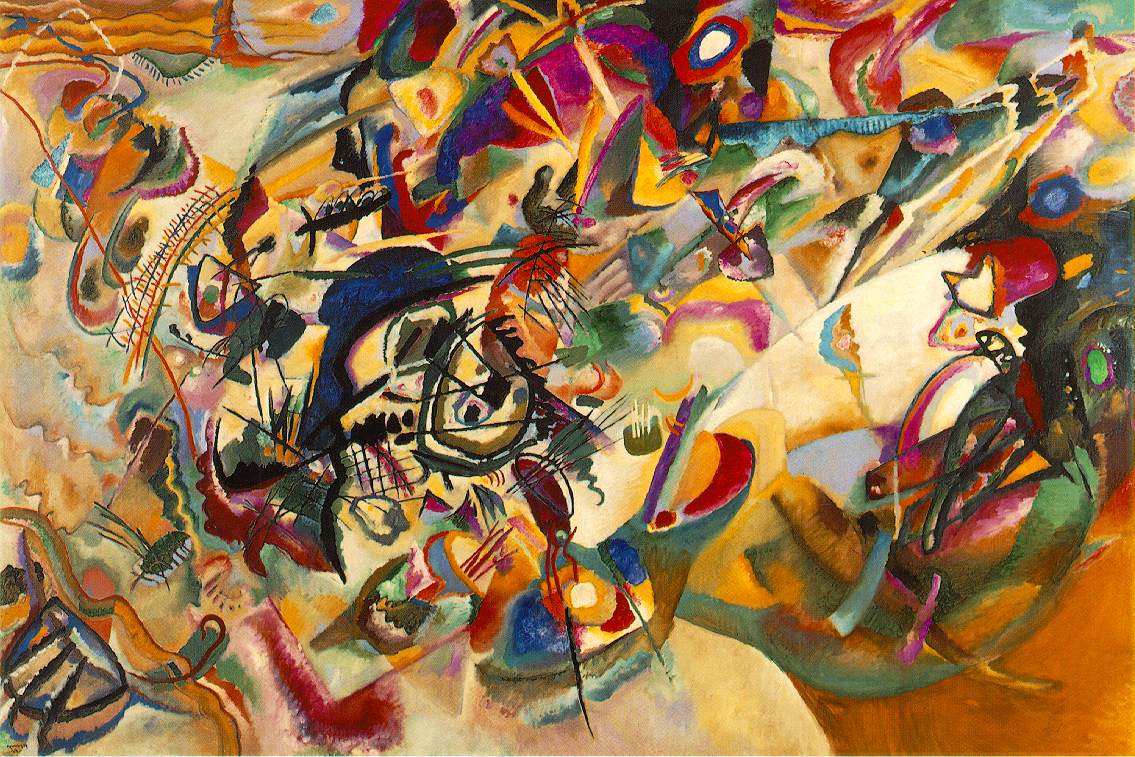
Kandinsky

Nuff said, really. I stared at this for five minutes, then realised I could be there for five years and I still wouldn't understand it. Amazingly, the next room was full of pictures like this. My brain got full.

Wednesday, August 02, 2006

Oxford


For anyone who was at Oxford, you'll hopefully like this. Sorry, I'm a lousy photographer. I've left making decent photographs to other people, so I'll hopefully just capture the day. The first photo sums up how I feel about Oxford: dreaming spires and transport containers.

Sanctus, and Julian forgets the difference between Handel and Vivaldi.

I'm afraid I didn't get any pictures of the punt trip. Bobster going in would have been essential.

"Cambridge was founded in 1269 by..."

What I didn't manage to capture was Tess's constant contradictions, which made the whole thing more like performance theatre.

Tell us more...

Lousy angle, but Davinia takes a good photo.

A rose between two thorns here. Sorry it's such a lousy picture, Kirsten.

Our fearless leader.